House of Atreus Family Tree Explained
The House of Atreus is one of the most famous families in Greek myth. This guide explains the House’s family tree, the family curse, and the tangled relationships between Tantalus, Pelops, Atreus, Agamemnon, Iphigenia, Elektra, Orestes, Clytemnestra, Menelaus, and Helen.
.png)
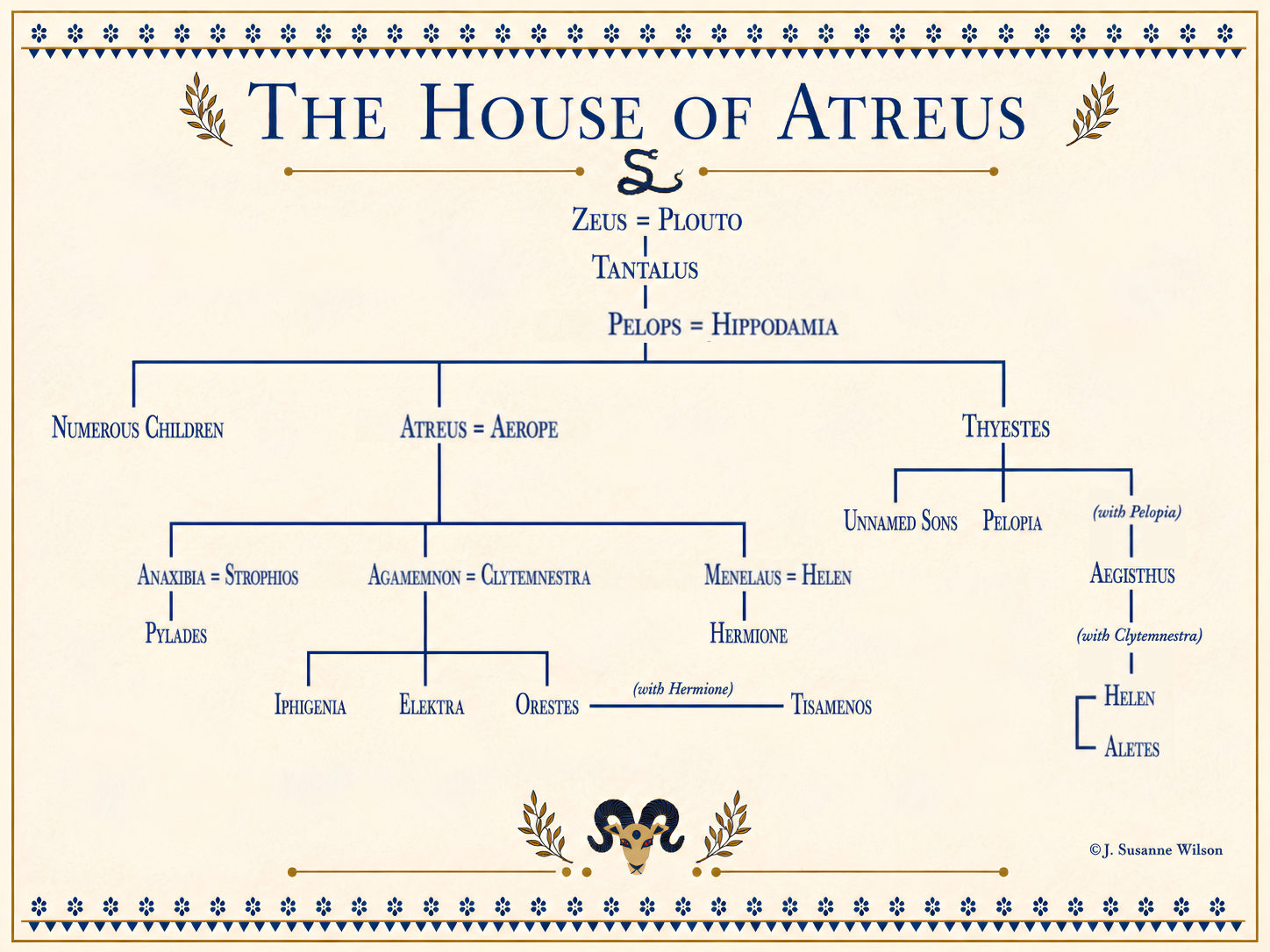
Quick Answer: Who Were the House of Atreus?
The House of Atreus was the mythological royal family of Mycenae, descended from Tantalus through Pelops, Atreus, Agamemnon, Menelaus, Orestes, and their relatives. The family was famous for a generational curse involving murder, betrayal, cannibalism, revenge, and divine judgment. Its stories appear throughout Greek tragedy, especially in works by Aeschylus, Sophocles, and Euripides.
Tantalus: The First Crime of the House
Zeus fathered Tantalus with the Oceanid Plouto. Tantalus was initially a favored mortal, granted the rare privilege of dining with the gods on Olympus. He repaid this honor with unspeakable hubris: he slaughtered his own son Pelops, cooked him into a stew, and served him to the gods. Most of the gods were not fooled. But Demeter, in distress after her daughter had been kidnapped, did eat the boy’s shoulder. The gods reassembled Pelops and brought him back to life, replacing his missing shoulder with ivory.
To punish Tantalus, Zeus cast him down to Tartarus where he was condemned to never eat or drink again. Instead, he was destined to stand in a pool of water beneath a fruit tree for eternity. Whenever he bent to drink, the water receded; whenever he reached for fruit, the branches pulled away.
Pelops and Hippodamia: The Curse Begins
Restored to life and with a new ivory shoulder, Pelops sought to win the hand of Hippodamia, daughter of King Oinomaos of Pisa in the western Peloponnese. But Oinomaos challenged every suitor to a chariot race, killing those he defeated. Eighteen suitors had gone before Pelops, and all had failed. To guarantee his victory, Pelops bribed the king's charioteer, Myrtilos, to sabotage Oinomaos's chariot. During the race, the king’s chariot fell apart and he died. Pelops then executed Myrtilos to silence him, but not before Myrtilos cursed Pelops and his entire lineage.
Atreus and Thyestes: Brothers, Betrayal, and the Golden Lamb
Pelops and Hippodamia had numerous children. Their twin sons, Atreus and Thyestes, were bitter rivals, each of them wanting the throne of Mycenae. Thyestes seduced Atreus’s wife, Aerope, and stole the golden-fleeced lamb that signaled rightful kingship of Mycenae. Atreus took his revenge in a manner chillingly reminiscent of his grandfather Tantalus: he slaughtered Thyestes's young sons, cooked them, and served them to their own father at a banquet. When Thyestes realized what he had eaten, he fled. Zeus, it was said, reversed the sun’s course in horror.
In some versions, Thyestes later fathered Aegisthus with his daughter Pelopia, continuing the family’s pattern of violence, concealment, and revenge. In shame, Pelopia abandoned the child who was both her son and half-brother.
Anaxibia, Agamemnon, and Menelaus: The Trojan War Generation
The curse continued with Atreus's and Aerope’s children. Anaxibia married Strophios, king of Phocis. Their son, Pylades, would later become Orestes’ loyal companion and help him carry out brutal vengeance against Clytemnestra and Aegisthus.
Agamemnon became the king of Mycenae and led the Greek forces in the Trojan War, but his path to battle was stained from the start. He sacrificed his own daughter Iphigenia at Aulis to appease the goddess Artemis and secure favorable winds for the fleet.
His brother Menelaus, king of Sparta, was the husband of Helen, whose abduction—or elopement—with Paris of Troy sparked the Trojan War.
The Murder of Agamemnon
While Agamemnon spent ten years at Troy, his wife Clytemnestra took his cousin Aegisthus as her lover. Fueled by vengeance for Iphigenia, Clytemnestra murdered Agamemnon when he eventually returned home. In the most famous version, she trapped him in a robe or net and stabbed him while he bathed. The curse of the house had come full circle, from father killing son to wife killing husband.
Iphigenia, Elektra, Orestes: The Attempt to End the Curse
In some versions, Iphigenia did not die by her father’s hand. Instead, Artemis whisked her away to the land of the Taurians, where she served as the goddess’ high priestess and oversaw ritual human sacrifice.
Elektra, the only child who remained in Mycenae, harbored a deadly grudge against her mother for butchering her father, Agamemnon.
Commanded by Apollo to avenge his father, Orestes returned to Mycenae and, with Elektra’s help, killed both Aegisthus and his own mother, Clytemnestra. For this act of matricide, the Erinyes (goddesses of vengeance) drove him mad and pursued him relentlessly. In some versions, The Erinyes drove Orestes to Tauris, where he met his eldest sister, Iphigenia.
Orestes was ultimately tried before a divine court in Athens, presided over by Athena. The jury was deadlocked, and Athena cast the deciding vote to acquit him.
The cycle of bloodshed that had begun with Tantalus was at last brought to a close, the curse finally spent.
Aletes and Helen: The Children of Clytemnestra and Aegisthus
Aletes and Helen, the children of Clytemnestra and Aegisthus, belonged to a later and less familiar branch of the family. They were still young when their parents died. In some traditions, Aletes was placed on the throne of Mycenae, only to be assassinated by Orestes later.
Hermione: The Final Generation
The only child of Menelaus and Helen, Hermione was married to the son of the hero Achilles after the Trojan War. On her husband’s death, she then married her cousin Orestes and bore their son, Tisamenos.
Tisamenos, one of the final heirs of the House of Atreus, was ultimately killed by descendants of Herakles.
The House of Atreus in My Books
My novels and stories explore the women of the House of Atreus as they try to survive the tragedies handed down to them. The Death and Life of Iphigenia follows Iphigenia beyond Aulis, while Aerope looks back to the earlier generation whose choices helped shape the family’s ruin.